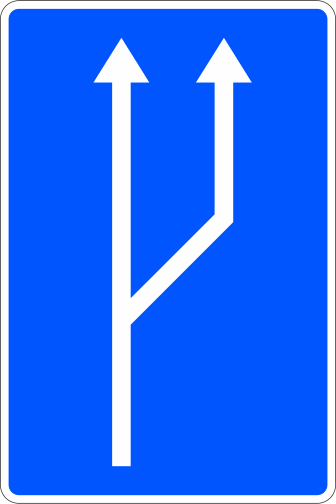
On a conventional road, after a stretch with a single lane in your direction, this sign appears. What does it announce?
Why
The arrows show the lane splitting: from there you will have two lanes in your direction. Keep to the right-hand one and use the left for overtaking. It is the opposite of a lane ending, and it does not mark the start of a dual carriageway either, which has its own sign.
Legal basis: RGC art. 146 y anexo I (S-53)
The same question in Spanish (if you take the exam in Spanish)
En una carretera convencional, tras un tramo con un solo carril en su sentido, aparece esta señal. ¿Qué le anuncia?
- Que comienza una autovía y cambian los límites de velocidad.
- Que el carril derecho se acaba y debe incorporarse al izquierdo.
- Que su sentido pasa de uno a dos carriles.
Share:
← Previous questionNext question →
More questions from this lesson
- You are in the right-hand lane of a two-lane carriageway and see this sign above the road. What does it tell you?
- You are on a single-lane carriageway and this sign appears. What should you expect?
- Beside the pavement of an avenue there is a lane with this sign. Who may use it?
- In a city park, a path is marked with this sign. How is traffic organised on it?
- You are cycling along a cycle route and this sign appears. What does it tell you?
- You find this sign as you enter a street. What does it indicate?
An original Drive Mundo question, written from the traffic rules. Not an official DGT question.