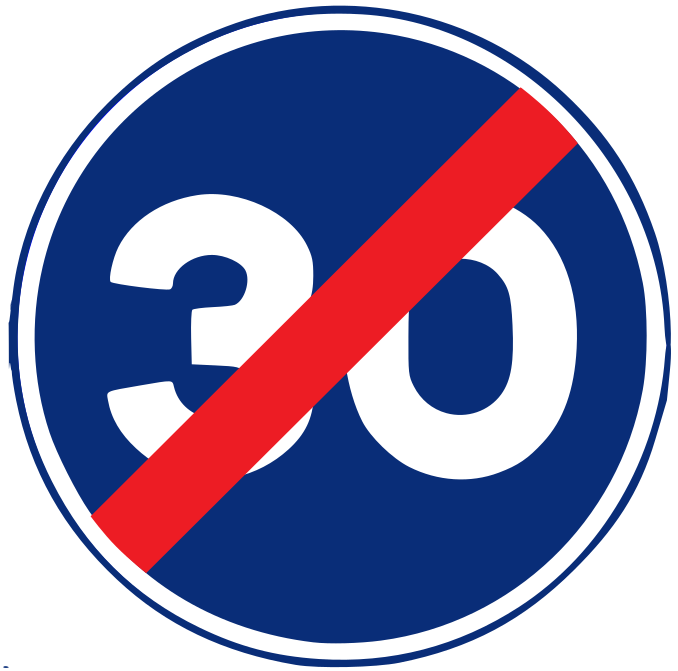
You are on a dual carriageway and come to this sign. What does it tell you?
Why
This is an end-of-obligation sign: it ends the minimum speed imposed by an earlier sign, which is why it is blue like other mandatory signs. The most common mistake is to confuse it with the end of a maximum limit, which is shown by a round white sign with the number crossed out.
Legal basis: RGC Anexo I (R-506)
The same question in Spanish (if you take the exam in Spanish)
Circula por una autovía y encuentra esta señal. ¿Qué le indica?
- El fin de la velocidad máxima aconsejada en el tramo.
- El fin del límite de velocidad máxima fijado antes.
- El fin de la velocidad mínima obligatoria.
Share:
← Previous questionNext question →
More questions from this lesson
- On a single-carriageway road limited to 90 km/h you want to overtake a lorry doing 85 km/h. To do it quickly you would need to reach 110 km/h. What should you do?
- Is the rule that allowed you to exceed the speed limit by 20 km/h to overtake on single-carriageway roads still in force?
- On a dual carriageway the fixed sign shows 100 km/h, but a variable message sign displays an 80 km/h limit. Which limit must you obey?
- On a dual carriageway with no speed signs, in good weather and light traffic, between which speeds should a car normally travel?
- What is a road's general speed limit?
- You are driving a car on a single-carriageway road with a hard shoulder more than 1.5 metres wide. With no specific signs, what is your maximum speed?
An original Drive Mundo question, written from the traffic rules. Not an official DGT question.