Course step 9 of 29 · Speed & distances
General speed limits
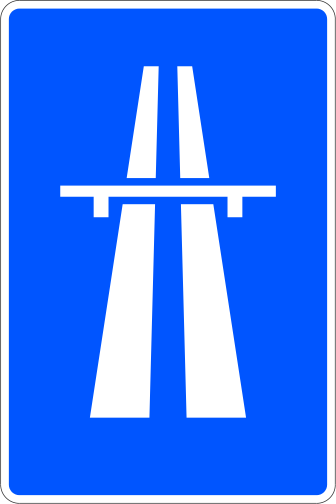
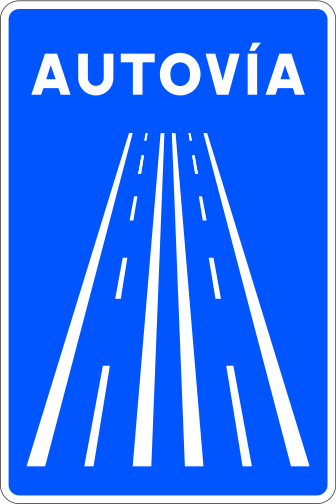
Outside built-up areas, a car may do at most 120 km/h on motorways and dual carriageways (autopistas and autovías), and 90 km/h on ordinary roads (carreteras convencionales). These are general limits: if a sign sets a different limit, the sign wins. An autovía has the same limit as an autopista, even though it can have access from adjoining properties.

How the law puts it«Para turismos y motocicletas, la velocidad máxima es de 120 km/h en autopistas y autovías y de 90 km/h en carreteras convencionales.» Check
What is the general speed limit for a car on a carretera convencional?
¿Cuál es la velocidad máxima genérica de un turismo en una carretera convencional?
On a carretera convencional the general limit for cars is 90 km/h.
You are driving a car on an autovía with no speed signs. What is your maximum speed?
Circula con un turismo por una autovía sin señales de velocidad. ¿A qué velocidad máxima puede circular?
Autopistas and autovías share the same general limit: 120 km/h for cars.
On urban roads and travesías (main roads passing through a town), the limit depends on the street: 50 km/h with two or more lanes in each direction; 30 km/h with a single lane in each direction; and 20 km/h on single-level streets, where road and pavement are at the same height and space is shared with pedestrians. Signs can set other limits.
How the law puts it«Vías urbanas y travesías: 20 km/h en plataforma única, 30 km/h con un carril por sentido, 50 km/h con dos o más.» Check
In town, what is the general limit on a two-way street with one lane in each direction?
En poblado, ¿cuál es el límite genérico en una calle de doble sentido con un solo carril para cada sentido?
With a single lane per direction the general urban limit is 30 km/h.
What general limit applies on an urban street where road and pavement form a single level?
¿Qué velocidad máxima genérica rige en una vía urbana de plataforma única de calzada y acera?
On a single-level street shared with pedestrians the general limit is 20 km/h.
Driving too slowly is also an offence if you hold others up. As a general rule, you may not drive below half the general speed limit for the road. On autopistas and autovías the minimum for a car is 60 km/h. You may only go slower if traffic, the road or the weather require it, or a sign allows it.


How the law puts it«No se deberá circular a velocidad anormalmente reducida, sin causa justificada, entorpeciendo la marcha de otros vehículos.» Check
What is the minimum speed for a car on an autopista, with no reason to go slower?
¿Cuál es la velocidad mínima de un turismo en una autopista, si no hay causa que lo justifique?
Half the 120 km/h general limit: 60 km/h.
There is thick fog on the autovía. May you drive below 60 km/h?
Hay niebla densa en la autovía. ¿Puede circular por debajo de 60 km/h?
The minimum speed does not apply when there is good reason, such as fog.
On ordinary roads you used to be allowed to exceed the limit by 20 km/h to overtake. That exception was abolished in 2019. Today, while overtaking you are bound by exactly the same speed limit as at any other time. If you cannot overtake without breaking the limit, do not overtake.
How the law puts it«Durante el adelantamiento no se podrá rebasar la velocidad máxima permitida en la vía.» Check
You are about to overtake in a car on a carretera convencional with a 90 km/h limit. What is your maximum speed?
Va a adelantar con un turismo en una carretera convencional limitada a 90 km/h. ¿A qué velocidad máxima puede hacerlo?
The 20 km/h overtaking margin no longer exists: the limit is the road's limit.
To overtake a lorry you would need to exceed the speed limit. What should you do?
Para adelantar a un camión necesitaría superar el límite de velocidad. ¿Qué debe hacer?
If you cannot overtake within the limit, you must not do it.
✓ Lesson complete
Chapter finished
Now lock it in with this chapter’s exam questions. That’s what helps you remember it most.